(c) Images Courtesy of the Leon Levy Dead Sea Scrolls Digital Library. Photo, Shai Halevi. www.deadseascrolls.org.il
Enoch is mentioned only briefly in Genesis 5:22–24, where he is listed as Noah’s great-grandfather. And yet, more legends were written about Enoch in the late Second Temple period than about almost any other biblical figure. The reason for this is that Enoch is the only person in the genealogical list where it is not said explicitly that he died. Instead, Enoch is said to have “walked with God” and then he vanish because “God took him”.
This enigmatic verse was understood in the Second Temple period as saying that Enoch never died. Instead, there were legends about how he traveled in the company of angels through the heavens and to the four corners of the earth.
These legends survive mainly in an Ethiopic text known as 1 Enoch, which is itself a collection of five separate books. Scholars once debated where these texts came from — and if they were even Jewish. All texts attributed to Enoch were written in the apocalyptic literary genre, and some argued that such texts were incompatible with ancient Jewish beliefs. This debate was resolved definitively when fragments of four of the five books of 1 Enoch turned up among the Scrolls in their original Aramaic. This also proved that at least some Jews had apocalyptic tendencies at the latest already by the 3rd century BCE – centuries earlier than some scholars had argued for when these beliefs first spread among Jews.
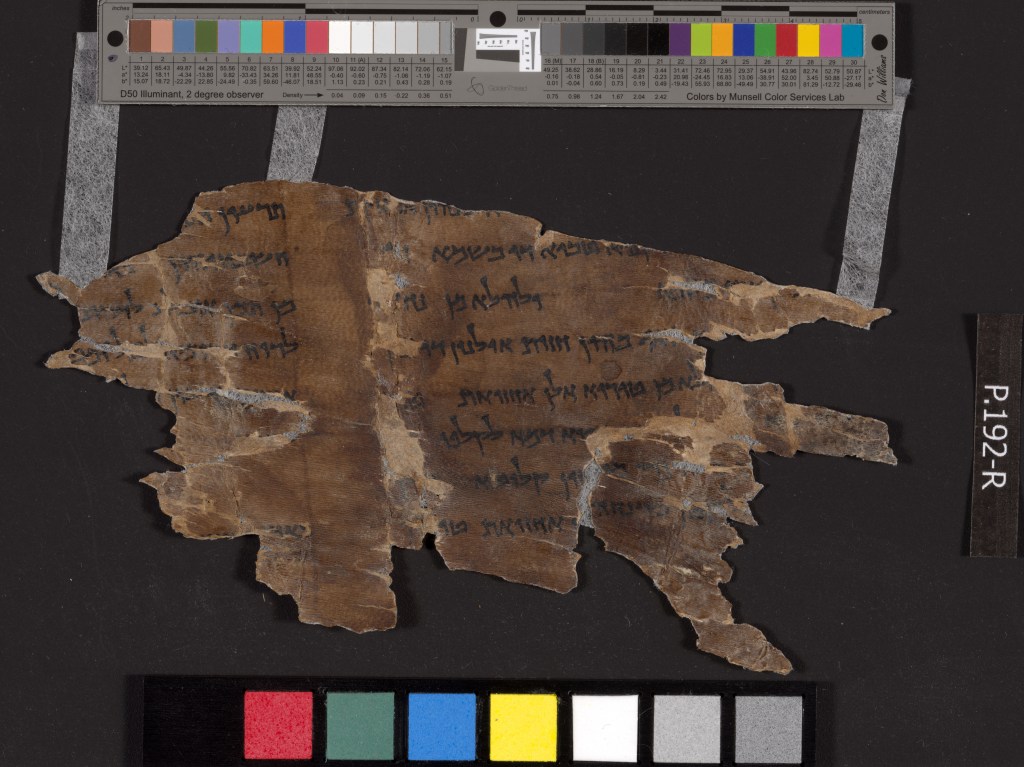
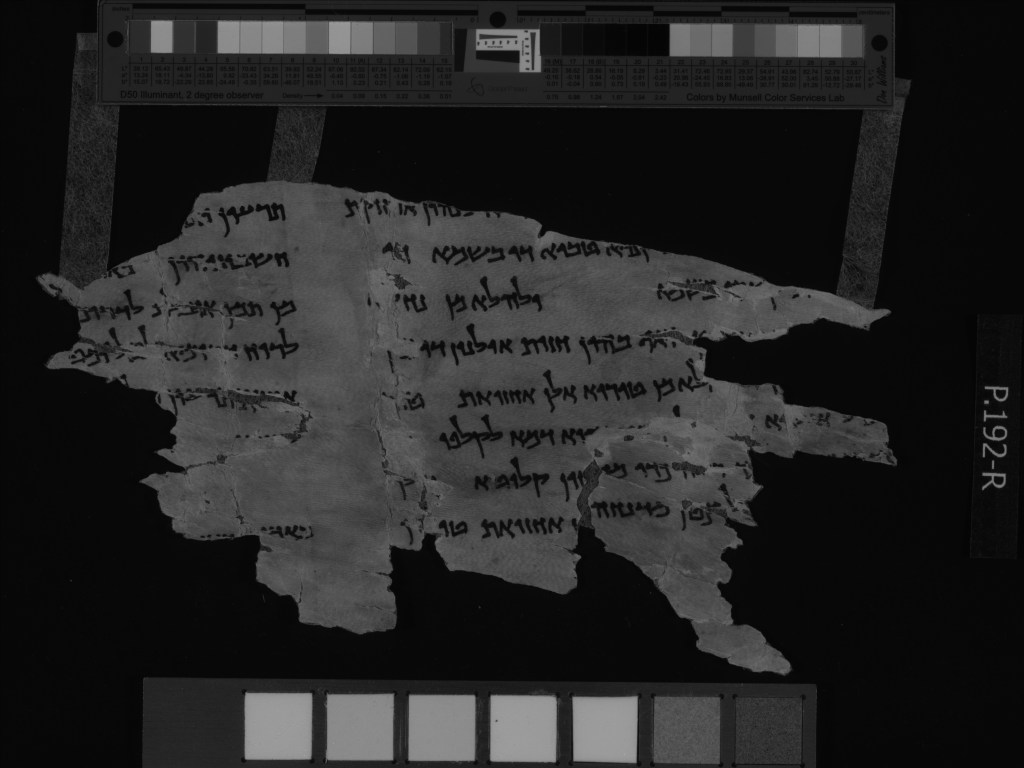
The fragment on display contains part of a description of Enoch seeing gates at the ends of the earth. In the south he sees three gates that are the origin of the south wind, the rain, and the dew. In the east he sees the three gates through which the stars enter the sky each night. It is due to these types of description that some scholars have nicknamed Enoch “the first astronaut”.
This fragment was previously on display in 2019 at an exhibit in memory of Ilan Ramon, Israel’s first astronaut who was killed in the Columbia Space Shuttle disaster.
Translation
Col. 12 (=1 Enoch 30:1-32:1)
23 [… and beyo]nd them I went away far,
24 [to the east, and I saw another huge place with valleys with abundant water in] which there were sweet-smelling reeds
25 [comparable to the mastic; and on the sides of these valleys] I [saw] the aromatic cinnamon. Blank And beyond [these] valley[s]
26 [I went on far to the East. I was shown] other [mountains] and in those, too, I saw trees from which issued
27 [the resin called styrax and galban]um. [And be]yond these mountains I was shown Blank [another] mountain
28 [to the East of the limits of the earth, and] all the trees [in it were f]ul[l] of …, which is comparable to the bark of the al[mond tree].
29 [When … in these trees there comes from them a] fragrant [aro]ma; when these barks are ground, Blank
30 [they are superior to any fragrance. Beyond these mountains,] towards the North-east of them, I was shown mount[ain]s
Col. 13 (=1 Enoch 35(?) + 36:1-4)
23 gates ope[n …]
24 their number. Blank Th[en …]
25 From there I was conveyed to the South of the e[nds of the earth, and there I was shown their three open gates]
26 for the South wind, for the dew and the rai[n and for … From there I was conveyed to the East of the ends of the earth and there]
27 I was shown [their] th[ree] gates, [open to the East … stars]
28 of the heav[en, going out …]
29 Blank [Blank]
30 Then … […]

