(c) Images Courtesy of the Leon Levy Dead Sea Scrolls Digital Library. Photo, Shai Halevi. www.deadseascrolls.org.il
Deuteronomy was the second most copied book found at Qumran (Psalms being the first). Between twenty-seven and thirty-two copies have survived. The exact number is up to debate since scholars have different opinions about whether certain fragments are part of the same manuscript or not. Most copies survive in only a few fragments. In several cases it also seems that these were not full copies of the entire book of Deuteronomy but rather extracts of select verses that were considered particularly important. In contrast, 4Q35 was probably a manuscript that originally contained the entirety of Deuteronomy. Its surviving fragments include verses from the beginning, middle, and end of the book. It therefore seems reasonable to assume that the manuscript once had the entire text.
The importance of Deuteronomy to the Scrolls community cannot be overstated. Beyond the large number of copies found among the Dead Sea Scrolls, the influence of the final book of the Pentateuch can be seen in almost every non-biblical text. For example, Deuteronomy is the earliest source to prohibit offering sacrifices to God outside of a single central sanctuary. This is understood in most of the non-biblical Dead Sea Scrolls to refer to the Jerusalem temple. Indeed, the Scrolls community never questioned the exclusive status of the Jerusalem temple, even though they themselves were probably excluded from it and claimed the temple had been defiled by the priests in charge of it.
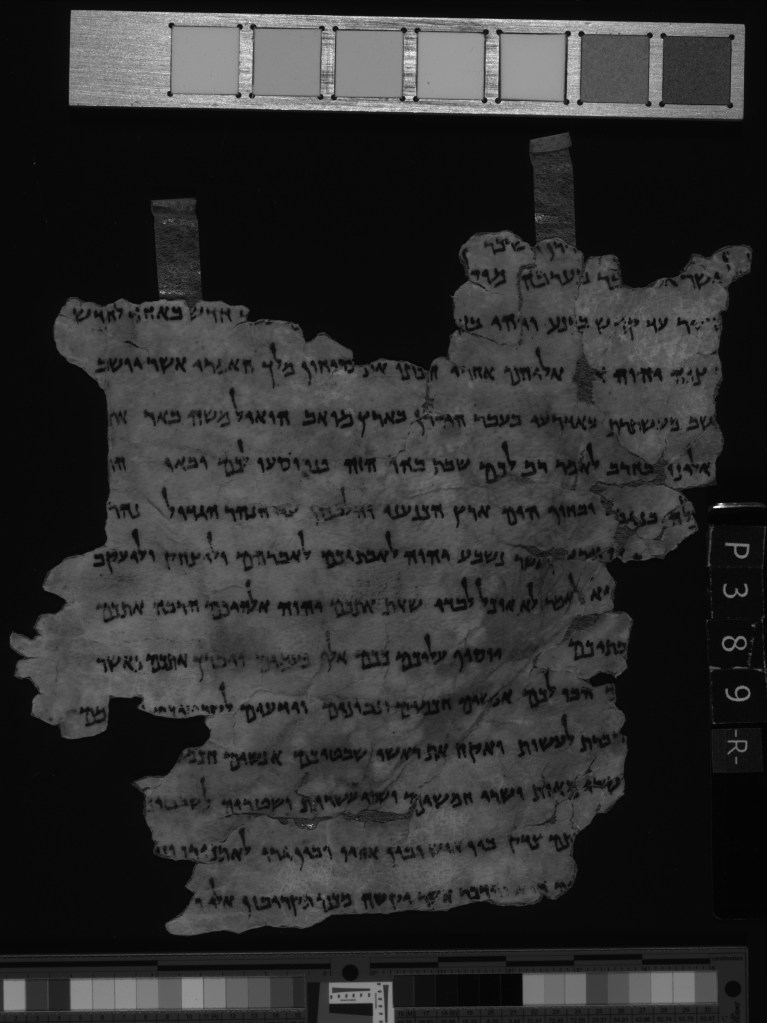
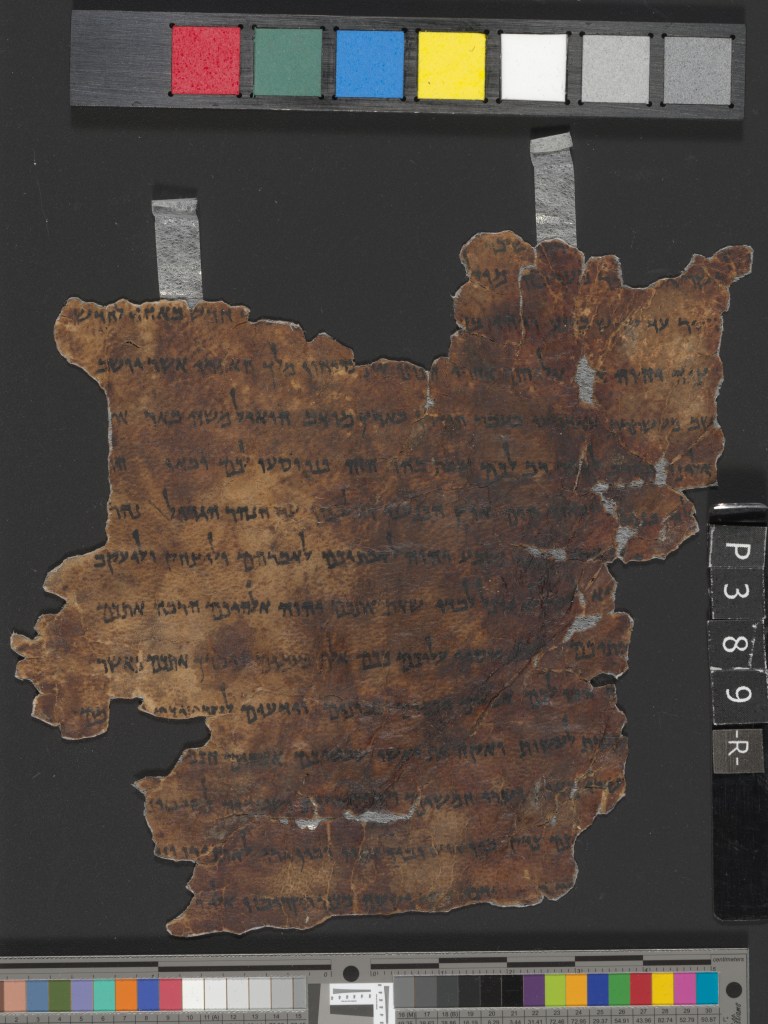
The fragments on display are of the first verses of the book, the opening of Moses’ final speech to the Israelites. The scribe made a mistake in the first verse and omitted two words that were then added above the line.
Translation
Frg. 1 (=Deuteronomy 1:1-17)
- [(1:1) These are the words which Moses spoke t]o all Israel [acr]oss [the Jo]rdan in the wilderness, in the Aravah opposite [Suph, between Paran, Tophel, Laban, Hazeroth, and Di-zahab. (2) Eleven days’ journey from Horeb]
- [by the way of Mount] Seir to Kadesh-barnea. (3) Then in the for[tieth year, in the ele]venth month, on the first day of the month,
- [Moses spoke to the people of Israel, according to all tha]t the Lord had commanded h[im] concerning them, (4) after he had defeated Sihon the king of the Amorites, who lived
- [in Heshbon, and Og the king of Bashan, who li]ved in Ashtaroth, at Edrei. (5) Across the Jordan, in the land of Moab, Moses began to explain
- [this Law, saying: (6) The Lord our God spoke] to us in Horeb, as follows: “You have dwelled long enough at this mountain; (7) turn and take your journey and go to the mountain
- [of the Amorites and to all their neighbors in the Aravah, in the mountain and in the lo]wland, in’ the Negev and in seacoast, the land of the Canaanite, and the Lebanon, as far as the great river, the river
- [Euphrates. (8) Behold! I have granted before you the land; go forth and inherit] the land which the Lord swore to your ancestors, to Abraham, and to Isaac, and to Jacob,
- [to give to them and to their descendants after them.” (9) And I spoke to you at th]at [time], saying, “I cannot bear you by my-self alone; (10) the Lord your God has multiplied you,
- [and you are this day like the stars of heaven in multitude. (11) The Lord, the God of] your [a]ncestors //// will increase you even more than you are a thousand times, and bless you, as
- [he promised you! (12) How can I alone bear your load and your burden and you]r[ strife] (13) Choose for you people who are wise and understanding and experienced, according to your tribes, and [I will pu]t them
- [at you heads.” (14) Then you answered me, and said, “The thing which] you have spoken [is good] to do. (15) So I took the heads of your tribes, people who were wis[e and experienced]
- [and appointed them as heads over you, commanders of thousands], and commanders of hundreds, and commanders of fifties, and commanders of tens, and officers, according to y[our] tribes.
- [(16) And I commanded your judges at that time, as follows: “Listen (to the cases) between your brethren, and jud]ge righteously between one person and his brother, and his resident foreigner. (17) You shall not show favoritis[m in judgment;]
- [the small and the great alike you shall listen to; you shall not be intimidated by any person, for the judgment belon]gs to[ Go]d. And a case that is too hard for you, you shall bring to me, a[nd I will hear it]”

