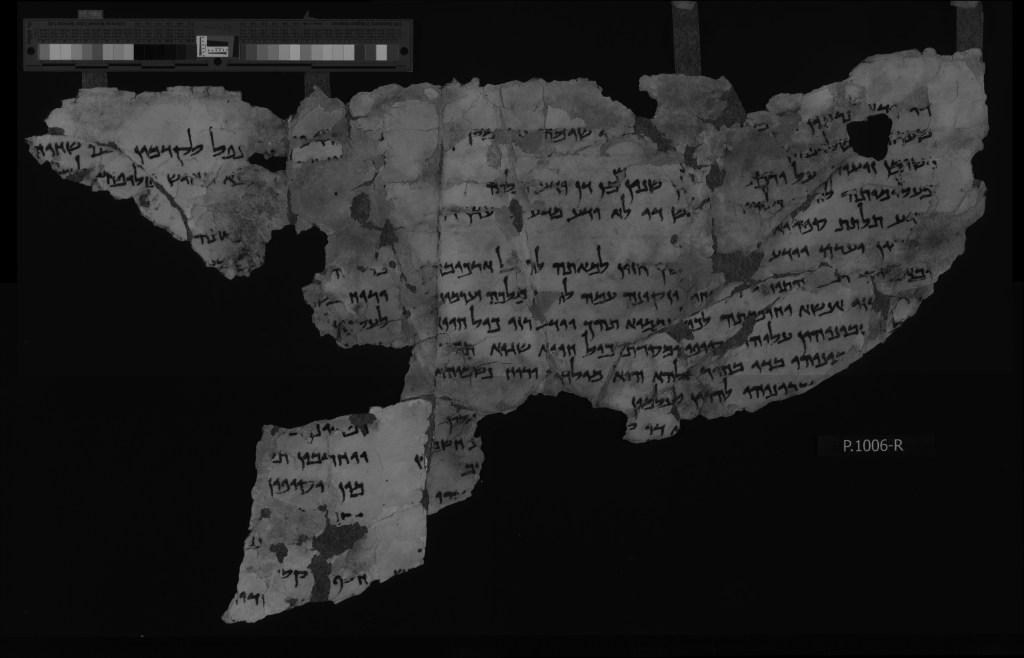
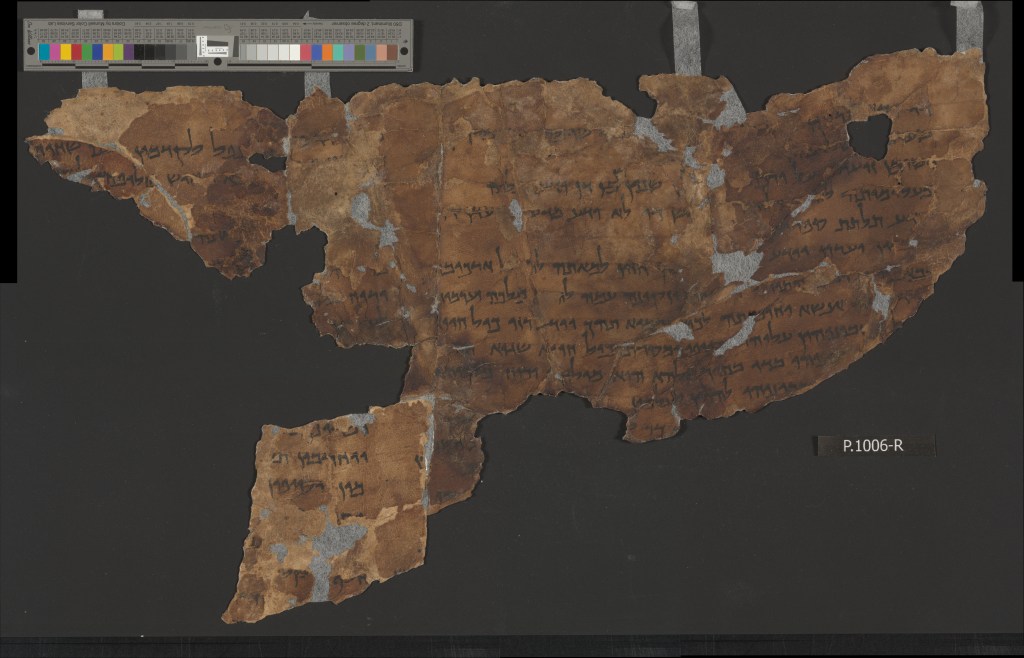
(c) Images Courtesy of the Leon Levy Dead Sea Scrolls Digital Library. Photo, Shai Halevi. www.deadseascrolls.org.il
Who is the “elect of God” described in these enigmatic Aramaic fragments? Three manuscripts (4Q534–536) survived to tantalize scholars with a birth narrative unlike anything in the Hebrew Bible—a child marked by destiny from his first breath. The scholarly debate remains unresolved. Some identify this figure as messianic, seeing in the text a prophecy of future redemption. Others connect the child to Noah, drawing on parallel traditions preserved in the Genesis Apocryphon and the Book of Enoch. The ambiguity may be intentional; ancient readers might have seen multiple layers of meaning where we see contradiction. The text unfolds in stages. First comes physical description—the child’s appearance matters, marking him as extraordinary from birth. Then the narrative shifts to his intellectual journey. His wisdom begins limited, constrained by youth or circumstance, but expands dramatically through study of “the three books.” Scholars debate the identity of these texts, though many point to Enochic literature as the likely source of this transformative knowledge. Through mastering these books, the protagonist gains divine wisdom—secrets of heaven and earth that transcend ordinary human understanding. But knowledge brings responsibility: he must share this revelation with others, becoming a conduit between divine and human realms.
The text darkens toward its end. Enemies plot against God’s chosen one, schemes laid to destroy him before his mission unfolds. Yet the narrative assures readers these conspiracies will fail. Why? Because this child’s selection comes from God himself, and divine election cannot be undone by human machination.
Detail Translation
Frg. 1 i
1 of the hand, two […] a mark; red is
2 his hair [and he has] moles upon […]
3 and tiny marks upon his thighs […] different from each other. He will know […]
4 In his youth he will be … [… like a m]an who knows nothi[ng, until] the moment in which
5 [he will] know the three books.
6 Then he will acquire wisdom and will know … […] … of visions, in order to
reach the upper sphere.
7 And with his father and with his [forefa]thers […] life and old age. Counsel and prudence will b[e] with him
8 [and] he will know the secrets of man. And his wisdom will reach all the peoples. And he will know the secrets of all living things.
9 [And al]l their plans against him will come to nothing, although the opposition of all living things will be great.
10 […] his [p]lans. Because he is the elect of God, his birth and the spirit of his breath
11 […] his [p]lans shall be forever.
12-17 … […] …
Frg. 1 ii + 2
1 […] which […] fell in ancient times. The sons of the pit […]
2 […] … evil. The mole […]
3
4 […] … […]
5 [… the] fle[sh …]
6 … […]
7 and the spirit of [the] so[ul …]
8 forever. […]
9-11 […]
12 and cities wi[ll …] and virg[i]ns which shall … […]
13 and they will destroy […] … they will destroy from the high places; all of them will com[e …]
14 The waters will cease […]
15 … […] and all of [th]em will be rebuilt. His deed will be like that of
the Watchers.
16 […] … […]hey will establish his foundation
upon him. Its sin and [its] gu[ilt]
17 Instead of his voice […] the Holy One and the Watchers […] saying:
18 […] … […] they spoke against him.
19 … […] …
20 … […] … [he] saw
21 […] … […] …

