(c) Images Courtesy of the Leon Levy Dead Sea Scrolls Digital Library. Photo, Shai Halevi. www.deadseascrolls.org.il
The Book of Jubilees claims extraordinary authority: it presents itself as direct revelation from the Angel of Presence to Moses on Mount Sinai, retelling the events of Genesis and early Exodus not as human interpretation but as heavenly disclosure. Yet despite these lofty claims, Jubilees never entered the canon of either the Hebrew Bible or the New Testament, earning its classification as apocryphal or intertestamental literature. Before the Dead Sea Scrolls emerged from the Judean Desert, scholars knew Jubilees only through translations—Greek fragments, Syriac versions, Latin excerpts, and most importantly, a complete Ethiopic text that preserved the work when other traditions had abandoned it. The book’s distinctive feature lies in its chronological architecture. Drawing on the jubilee concept from Leviticus 25:8–11, the author divides all biblical history from creation to Sinai into 49-year periods called “jubilees.” This isn’t mere organizational preference—it’s a theological statement. By structuring sacred history into these precise cycles, Jubilees argues that time itself follows divine pattern, that history unfolds according to heaven’s mathematics. The text also champions a 364-day solar calendar, placing it at odds with the lunar calendar tradition. This seemingly technical detail carried profound implications for festival dates and religious practice—questions that divided Second Temple Jewish communities. The Dead Sea Scrolls revolutionized Jubilees scholarship. Fifteen manuscripts surfaced from the Qumran caves, all considerably older than any previously known copies. More importantly, these represented the first Hebrew versions ever discovered—revealing at last the language in which Jubilees was originally composed, before it migrated into Greek, Syriac, Latin, and ultimately found sanctuary in Ethiopic.
Detail Translation
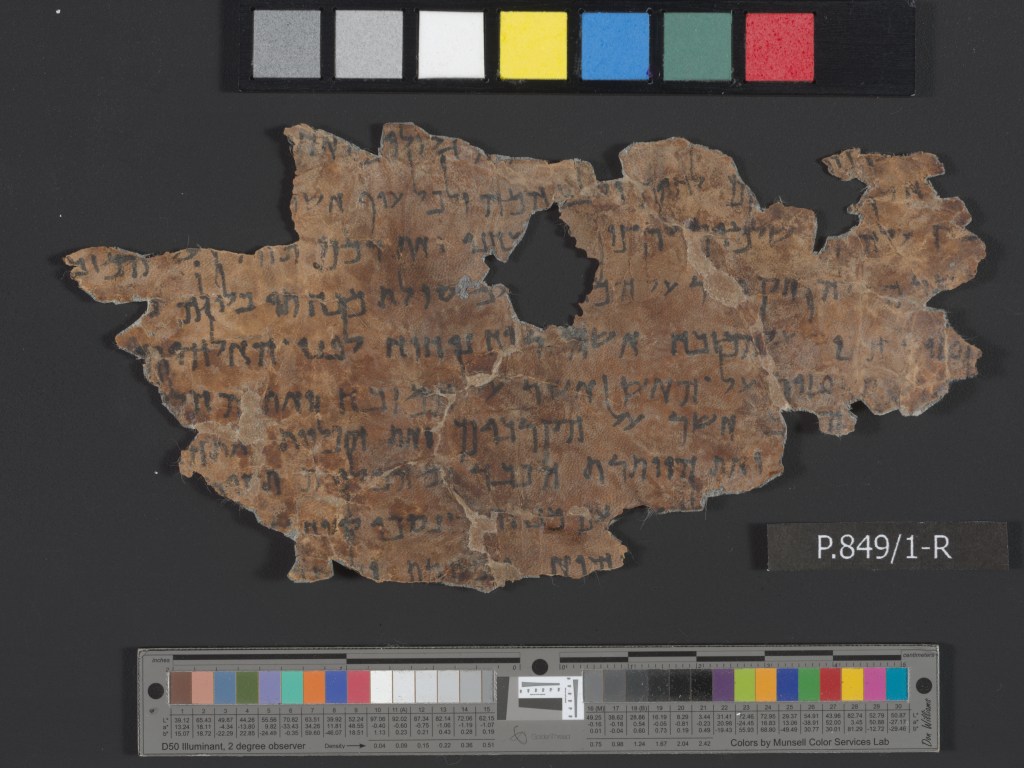
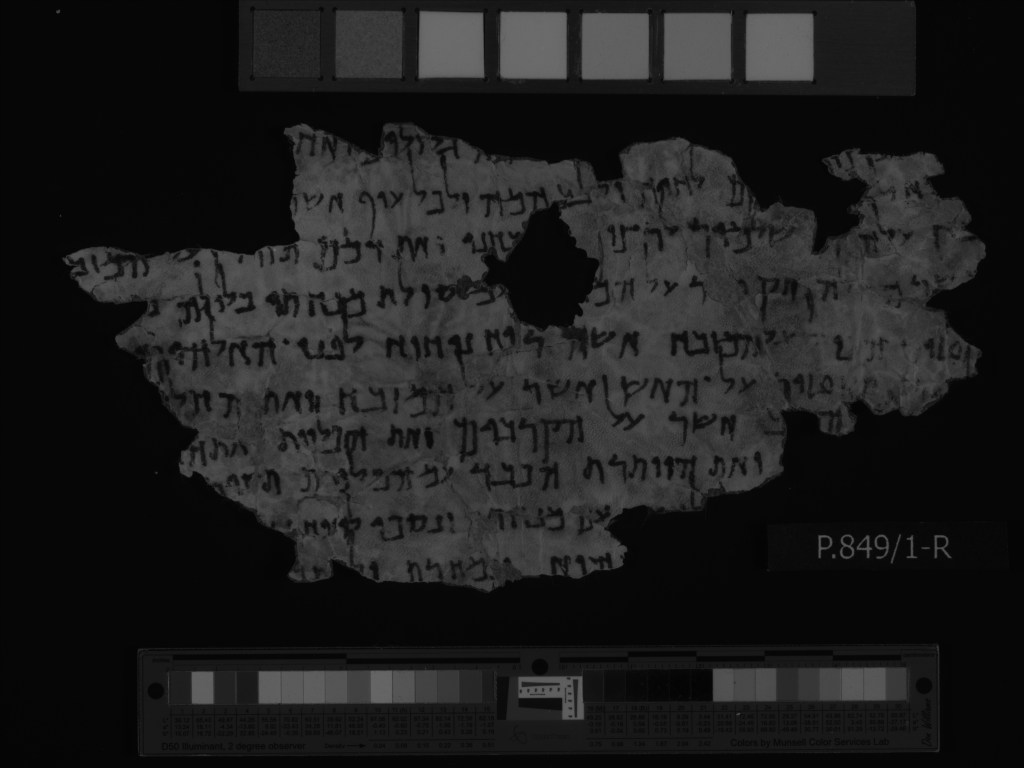
Frg. 1 (= Jubilees 21:5-10)
1 [his precepts, his] commandments [and his decrees; and do not go af]ter idols or after [images or after]
2 [cast effigies. And] do not [eat any blo]od of an animal, cattle or any bird which [flies in the sky.]
3 [If you sacri]fice (as) a burnt-offering a peace-offe[ring], according to (his) will you shall [sac]rifice it and pour the blood over the alt[ar.]
4 [And all] the meat of the burnt-offering you shall offer upon the al[tar] with the flour of its offering mixed with [o]i[l],
5 [with its libation. You] shall offer everything upon the altar, a fire-offering with a pleasant fragrance before God. [The fat of]
6 [the pe]a[c]e-[offering] you shall offer on the fire which is upon the altar,
and the fat [which is on]
7 [the intestines and] the [f]at which is on the entrails and the kidneys [and] the [fat which is upon them]
8 [and that which is on the loins] and the appendix of the liver with the kidneys you shall remove, [and you shall offer]
9 [it all as a pleasant fragrance before G]od with its offering and its libation as a plea[sing] fragrance, [bread of the fire-offering]
10 [for God. Eat its meat on the] same [day] and the following day; but [the sun] mu[st] no[t set on it].
11 […] … […]
 Dead Sea Scrolls: The Exhibition at museum of the bible - Nov. 22, 2025-Sep. 6, 2026