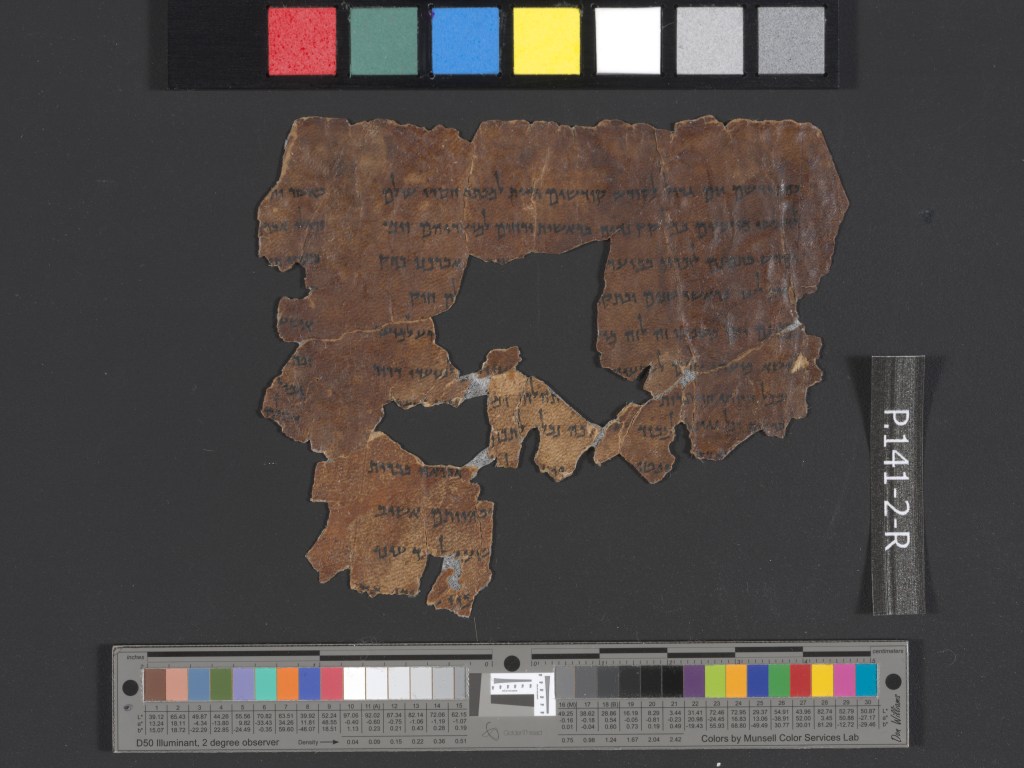
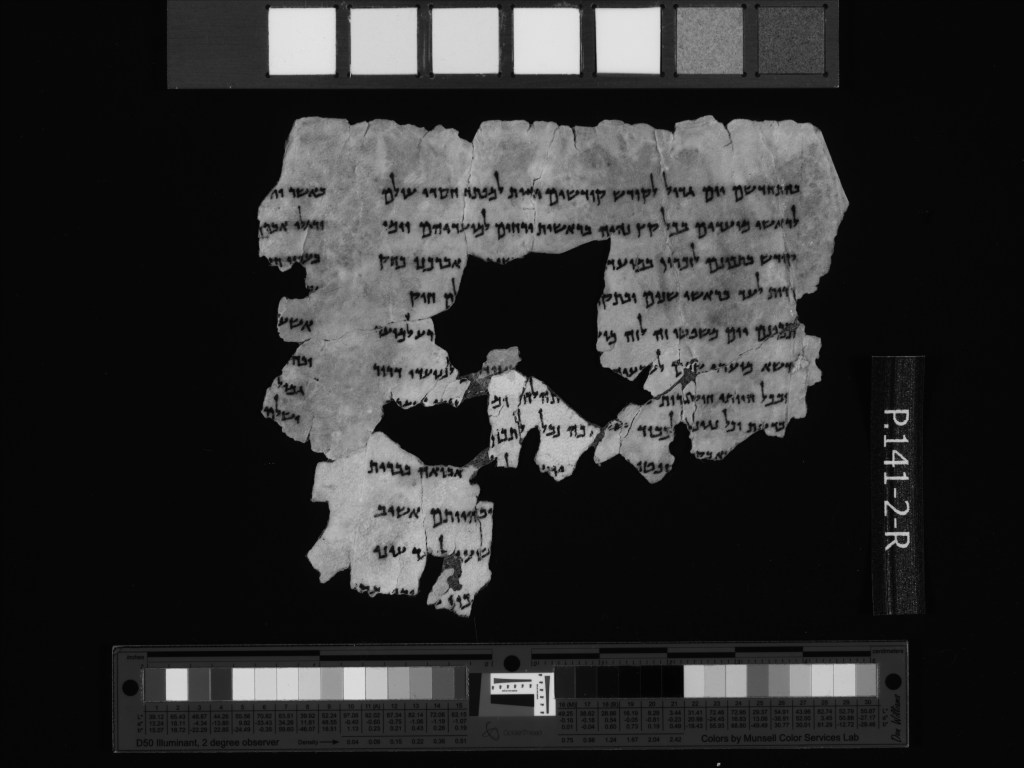
(c) Images Courtesy of the Leon Levy Dead Sea Scrolls Digital Library. Photo, Shai Halevi. www.deadseascrolls.org.il
The Community Rule ranks among the most revealing manuscripts discovered at the Qumran caves, preserved in more than a dozen copies—testimony to its central importance. Here, encoded in Hebrew script, lies the constitution of a desert group that called itself the Yahad, “the community.” This text opens a window onto their world: their theology, their discipline, their vision of what it meant to draw near to God while the rest of Israel, in their view, had strayed. The Yahad bound itself through covenant, renewed annually in a ritual of confession and recommitment—each year a fresh beginning, each member reaffirming their place among the chosen. But entry came neither quickly nor easily. Prospective members faced a three-year probationary period, their conduct scrutinized and understanding tested at every stage. Only those who proved both faithful and comprehending could join the inner circle. The resemblance to Josephus’s Essenes cannot be ignored. The famous Jewish historian described a sect whose practices mirror much of what appears in the Community Rule. Yet the scrolls themselves never use the name “Essenes,” leaving scholars to debate: Are these the Essenes? A subgroup within that movement? Or an entirely separate Jewish sect lost to history until the caves revealed their existence? Radiocarbon dating of this particular copy confirms its first-century CE origin—placing it within living memory of the community’s final days, before Roman legions swept through Judea and Qumran fell silent.
Detail Translation
Col. IX
1 renewing each other. It is a great day for the holy of holies, and a sign of the opening of everlasting mercies,
2 for the beginnings of the seasons in every future age. At the commencement of the months in their seasons, and of the holy
3 days in their sequence, as a remembrance in [their] seasons. [With the offering of] lip[s], I shall bless him, in accordance with the law
4 [es]tablished for ever. At the commencement of the years and in the tu[rning of their seasons, when] the law
5 of their disposition [is carr]ied out, on its prescribed day, one after another; the sea[son of the harvest up to summer, the season of seed-]time up to the season of
6 the grass, the seasons of y[ear]s up to their seven-year periods. [At
the commencement of the se]ven-year periods, up to the seasons of deliverance.
7 And in all my existence the law will be [en]graved on [my tongue to be a fruit of] eulogy and a por[tion] (of offering) of my lips. I shall sing
8 with knowledge and for the glory of God shall all my music be, the
strumming of my harp to [his holy] order, [and the whistle]
9 [of my lips I shall] tune to its [co]rrect mea[sure. At the onset of] day [and ni]ght I shall enter the covenant
10 [of God, and when evening and morning depart I shall repeat his
laws;] and while they last I shall turn back
11 [my limit without turning away. I acknowledge his judgment to be right according to my pervertedness;] my [c]rimes are before my eyes,
12 [like an engraved law. And to God I shall say: ‘My justice’, and to the Most High:] ‘Establisher of my wellbeing’, ‘sou[rce of]
13 [knowledge’, and ‘dwelling of holiness’, ‘peak of glory’, ‘all-powerful one of eternal majesty’. I shall choose]
Col. X
1 what he instructs [me, and I shall be pleased in how he might judge me. When I start to stretch out my hands]
2 and my feet I shall [bless his name, and I shall bless him before lifting up my hands to get fat]
3 on the tasty fr[uit of the earth. At the onset of fright and dismay, in the place of distress] 4 an[d grief, I shall bless him for (his) great marvels and shall meditate on his power, and on his compassions]
5 I shall rel[y the whole day. I shall know that in his hand lies the judgment of every living being, and all his deeds are truth.]
6 When [distress is unleashed I shall praise him, and for his deliverance I shall sing to him . I shall not repay anyone with an evil]
7 reward; [with goodness I shall pursue man. For to God (belongs) the judgment of every living being, and it is he who]
8 shall repay [ a person his reward …]

